1. Tell us what happened and where the property is
The first conversation helps establish the type of loss and whether an urgent safety issue remains. We need the property's street address, city, ZIP code, a short description of the damage, when it began or was discovered, and whether the source is still active. Let us know if water is near electricity, whether a fire department has released the building, whether sewage or floodwater is involved, and which rooms or floors appear affected.
In Haltom City, a location description may include Browning Heights, Diamond Oaks, Fossil Ridge, Haltom Acres, Meadow Oaks, Oak Knoll, or nearby routes such as Denton Highway, Broadway Avenue, Beach Street, Haltom Road, and Northeast Loop 820. These references help orient the conversation, but the exact property address is necessary to confirm current service availability. If you are in North Richland Hills, Hurst, Bedford, Colleyville, Fort Worth, Arlington, Burleson, Roanoke, Haslet, or another listed community, provide the full location rather than assuming every part of a city has identical dispatch arrangements.
Home Mold Water Fire Damage offers 24/7 emergency response. Actual dispatch depends on location, demand, access, and the nature of the loss; we do not publish a universal arrival-time guarantee. If there is a fire, gas leak, electrical danger, structural collapse risk, or immediate threat to life, contact emergency services before arranging restoration.
2. Make the immediate area safe
Safety comes before equipment setup or cleanup. After water damage, do not enter standing water if outlets, wiring, appliances, or electrical panels may be affected. Do not touch electrical equipment while standing on a wet surface. If the water source is a plumbing fixture or supply line, shut it off only if the valve can be reached safely. A licensed plumber should repair plumbing components when the work requires a plumbing license. Restoration work addresses the resulting building damage; it does not replace the trade responsible for repairing the source.
After a fire, wait until the fire department or appropriate authority says the property is safe to enter. Hidden hot spots, unstable ceilings, damaged wiring, compromised floors, and smoke residues can remain after visible flames are out. Do not turn on fans or central HVAC equipment without understanding whether they could spread soot or other contaminants. For sewage or unknown floodwater, avoid contact and keep occupants away until the condition is assessed.
Some properties require utility isolation, specialist inspection, controlled access, or additional precautions. A restoration contractor should never ask an occupant to ignore an unsafe condition simply to speed up the job.
3. Inspect the affected property and understand the loss
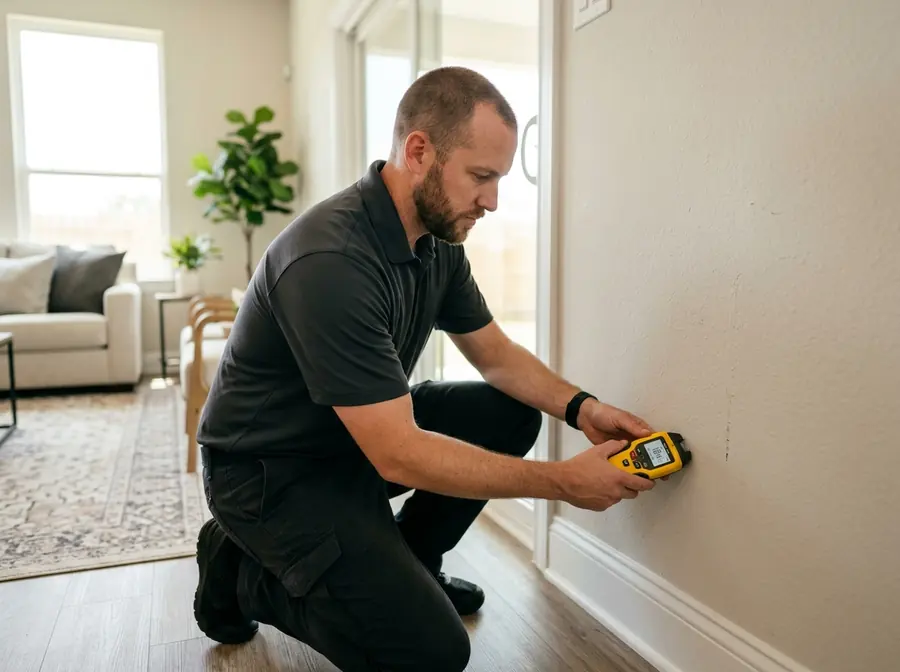
The assessment is shaped by the type of damage. For water losses, the source, water category, affected rooms, visible wet materials, concealed cavities, and moisture migration all matter. A technician may use appropriate moisture-measuring tools and visual inspection to identify areas that need further attention. A small stain on a ceiling can be connected to a leak from another level; a wet floor may have moisture below the visible covering. The inspection should distinguish what is known from what still needs to be checked.
For fire and smoke losses, the assessment considers the area directly affected by flames, smoke movement, soot deposits, odor, contents, building materials, and any water introduced during firefighting. The room where the fire started is not necessarily the only room affected. The building's ventilation paths and layout can influence where residue travels.
For suspected mold, the process must respect Texas licensing rules. TDLR describes mold assessment as inspection or surveying to provide information about mold presence or a remediation plan. Remediation is the removal, cleaning, sanitizing, or other treatment of mold or mold-contaminated matter. These are regulated roles with independence requirements. The appropriate licensed professional must handle each activity, and a licensee cannot simply perform both roles on the same project where the rules prohibit it. The need for an independent mold assessment should be explained before regulated work proceeds. Consult the TDLR Mold Assessors and Remediators program for current requirements.
4. Explain the proposed scope before work moves forward
Once the conditions are understood sufficiently, the proposed scope should describe the work being considered and the reason for it. For a water loss, that may include extraction, removal of certain wet materials, drying equipment, dehumidification, monitoring, and cleaning. For fire damage, it may include residue removal, contents handling, odor treatment, temporary protection, and coordination of repairs. For mold remediation, it must follow the applicable assessment information, licensing requirements, and project-specific rules.
Ask which areas are included, which materials may be retained or removed, what equipment is expected, whether the project needs another licensed trade, and what could change after concealed conditions are discovered. A responsible scope distinguishes emergency mitigation from reconstruction. It should also explain exclusions, assumptions, access needs, and how changes are communicated. The property owner should understand the authorization before signing it.
Insurance may add another layer of communication. Your insurer decides coverage under your policy, not the restoration contractor. If you are making a claim, ask the insurer what documentation and authorization it requires. Keep photographs, inventories, receipts, and written communications. Our insurance claims help guide explains how to organize this information without assuming that any particular loss is covered.
5. Begin the appropriate restoration work
Water extraction and removal
When water is present, an early technical stage may involve removing accessible standing water. The method depends on the amount of water, surface, access, and whether contamination is suspected. The objective is to remove accessible water while protecting occupants and avoiding the spread of contaminated material. Water from a clean supply line is not handled in the same way as sewage or storm floodwater. The water category affects worker protection, material decisions, cleaning, and disposal.
Drying and moisture control
After extraction, drying may involve air movers, dehumidifiers, monitoring, and adjustments as materials respond. Air movement alone does not prove that a wall cavity or subfloor is dry. Moisture readings and the condition of materials help guide decisions. If materials cannot be dried safely or appropriately, removal may be necessary. Learn more about water damage restoration and structural drying and dehumidification.
Fire and smoke cleaning
Fire restoration may involve controlled removal of soot and smoke residue from appropriate surfaces, treatment of affected contents, odor management, and temporary protection. The correct method depends on the residue, material, and extent of damage. Some items can be cleaned; others may be too damaged or unsafe to retain. Structural repair and trade work may be separate from initial cleanup. See our fire and smoke damage restoration hub.
Mold remediation
Where regulated mold remediation is appropriate, the work must follow the relevant assessment, work plan, licensing, notification, containment, worker-protection, and verification requirements that apply to the project. The objective is not simply to make a visible patch disappear. The moisture source must be addressed, affected material handled appropriately, and required documentation completed by the responsible licensed parties. Requirements depend on the project and current Texas rules.
6. Monitor conditions and adjust the plan
Restoration is not always a one-visit task. Water drying may require repeated checks because different materials release moisture at different rates. Equipment may be repositioned or adjusted as readings change. A room that looks dry can still have moisture in concealed areas, while one material may be ready for the next stage before another material in the same room. The technician should explain what is being monitored and what the readings mean for the work.
Fire cleanup may also reveal additional affected surfaces as contents are moved or residues become visible under different lighting. Mold-related work may require the responsible licensed professional to verify that the project meets applicable criteria. When findings change the scope, the reason should be communicated. Unexpected conditions are not a reason to proceed silently with work the customer has not authorized.
For a commercial building, monitoring and access may need coordination around business operations, tenants, staff, inventory, and safety zones. For a residence, the plan may need to account for family routines, pets, stored belongings, and rooms that must remain accessible.
7. Clean up, document the work, and discuss what comes next
At the end of the restoration scope, the affected work area should be left in the condition described in the agreement, subject to the limits of the work performed and any outstanding repairs. The customer should be told what work was completed, what materials were removed or retained, what monitoring or verification was performed, and whether additional work remains. Where applicable, ask for copies of reports, photographs, moisture records, invoices, and required project documentation.
Mitigation and reconstruction are often separate phases. New drywall, flooring, cabinetry, insulation, painting, framing, or roof work may require separate estimates, trade contractors, permits, or inspections. The need for a permit depends on the nature of the work and the local authority. Do not assume that a restoration invoice automatically includes every repair needed to return the property to its prior condition.
Before belongings are returned to an area, make sure the work area is ready and any safety restrictions have been lifted. If the insurer is involved, provide the documentation it requests and keep a copy for your records.
How the process differs by type of property damage
A sudden plumbing leak in a Haltom City house
A supply-line failure in a home in Browning Heights or Diamond Oaks might require a plumber to stop the leak, a restoration assessment to trace water migration, extraction where water has pooled, and drying of affected materials. The work may be contained to one room or extend to adjoining areas depending on the building assembly. A stain is a starting clue, not a complete map of the moisture.
Storm water entering a property
After heavy rain, the first questions are whether water entered through a roof or opening, whether surface water or drainage is involved, and whether the water may be contaminated. Properties near Big Fossil Creek or Little Fossil Creek can have different parcel-level conditions, but proximity alone does not establish flood exposure. A safe assessment should consider the actual water source, the building, and affected materials.
Smoke residue after a kitchen fire
A kitchen fire can leave soot on cabinets, ceilings, appliances, and contents, while smoke may travel into adjacent rooms. Firefighters may also have used water that affects flooring or lower cabinets. Cleanup planning should distinguish fire residue, smoke odor, water damage, and structural concerns rather than treating the entire event as a single surface-cleaning task.
Commercial water or fire loss
In an office, retail space, warehouse, or multi-unit building, the process may require building-management approval, tenant notices, restricted access, inventory protection, and scheduling around business activity. The project should identify who can authorize work and who receives updates. Shared systems or adjacent units can complicate responsibility, so the affected area and roles should be clarified early.
What we need from you to keep the project moving
Customers can help by providing accurate information about the source, timeline, previous repairs, building access, and known hazards. Tell the team if a leak has happened before, if the roof or plumbing has been repaired, whether the property has been vacant, and whether there are rooms or contents that require special handling. For a commercial site, identify the facility contact, operating hours, access rules, and restricted areas.
Keep important documents together and respond to reasonable requests for access or decisions. If you need time to review a scope, say so. If an insurer, landlord, tenant, or property manager must approve work, identify that person early. Clear communication reduces confusion about what has been authorized and who is responsible for each decision.
Do not attempt hazardous demolition, electrical work, roof access, or contaminated cleanup to make the project easier. Leave regulated work and specialist trades to appropriately qualified professionals. If you notice a new leak, smell, or safety issue while work is underway, report it promptly.
Frequently Asked Questions About the Restoration Process
Will every restoration project follow these exact steps?
No. The sequence is a general guide. A small water loss, a large fire, and a regulated mold remediation project have different requirements. Emergency safety, the source of damage, contamination, building materials, and applicable rules determine the actual work plan.
Can you tell me the total project time at the first call?
We can discuss likely stages, but a reliable timeline depends on inspection, material conditions, drying progress, cleaning needs, and reconstruction or permit work. A fixed duration should not be promised before the scope is understood.
Do I need to leave my home during restoration?
That depends on safety, the affected area, equipment, contamination, utilities, and the work being performed. Ask whether rooms can remain occupied and follow instructions from emergency authorities or qualified specialists.
Who repairs the pipe, roof, or electrical system?
Those repairs may require a licensed plumber, roofer, electrician, or another specialist. Restoration addresses damage to the building and contents within its scope; it does not replace a regulated trade.
How will I know when water drying is complete?
The project should use appropriate monitoring and material assessment rather than relying only on appearance or touch. Ask what readings were taken, which materials were checked, and what criteria were used to decide the drying stage was complete.
Start a Restoration Conversation With Home Mold Water Fire Damage
If your property in Haltom City or a nearby community has water, fire, smoke, or mold damage, contact Home Mold Water Fire Damage to discuss the situation. Our team brings more than 13 years of experience, trained technicians, professional restoration equipment, locally based offices in the suburbs we serve, and 24/7 emergency response. Share your address, the type of loss, and any immediate safety concern so we can discuss the next appropriate step.
Learn more about our company, explore the communities we serve, or contact us through the emergency contact page. For a specific service, visit our water damage restoration and fire and smoke restoration hubs.