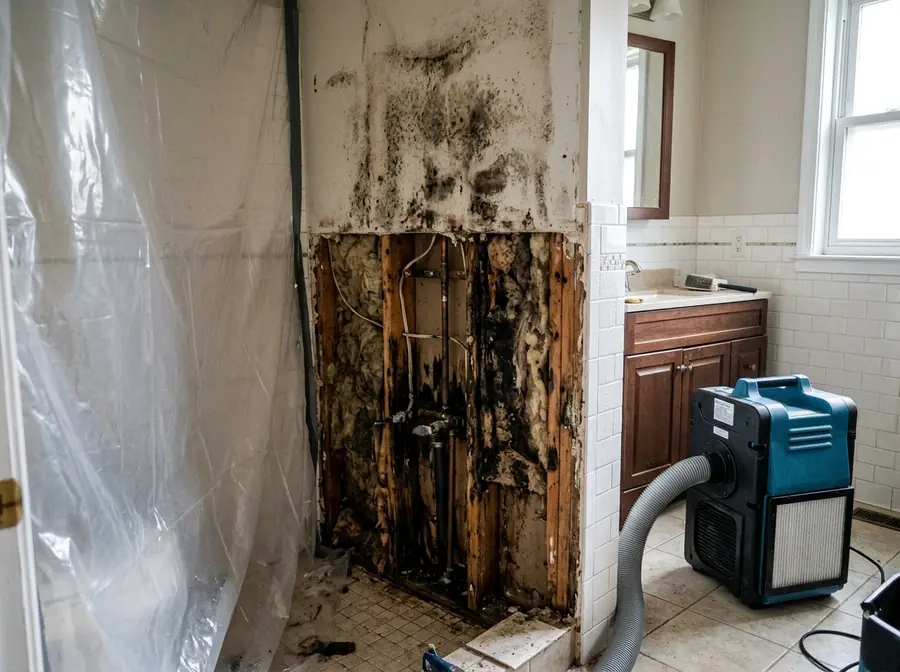
What a mold inspection should help you understand
A useful inspection is not simply a search for black spots. Mold can appear in different colors and textures, and discoloration can also have causes unrelated to mold. A property review should consider the history of leaks, roof or plumbing problems, condensation, ventilation, humidity, building materials, and areas where moisture may be concealed. A musty odor can be a reason to investigate even when visible growth is limited.
Potential areas of concern include bathrooms, kitchens, laundry spaces, attics, crawl spaces, closets, utility rooms, HVAC components, and locations around windows or plumbing penetrations. Water stains, peeling paint, swollen trim, soft drywall, warped flooring, and repeated condensation can indicate that moisture needs attention. None of these signs alone identifies a mold species or establishes the full extent of a problem.
The most important part of mold control is moisture control. If a leak or condensation problem remains active, cleaning visible growth without correcting the source can lead to recurrence. An inspection should therefore consider both the affected material and the conditions that allowed it to become damp.
Mold inspection, mold assessment, and mold testing are not the same thing
General moisture and building-condition review
A restoration professional may review visible water damage, moisture readings, drying conditions, and building materials as part of a water-damage or remediation project. This can help identify where drying, removal, or repairs may be needed. It should not be confused with a regulated mold assessment or represented as a laboratory diagnosis.
Regulated mold assessment in Texas
Texas regulates mold assessment and mold remediation under the Texas Department of Licensing and Regulation (TDLR). A formal mold assessment is conducted by appropriately licensed mold assessment professionals or companies within their authorized scope. Depending on the project, the assessment may document visible mold, evaluate the extent of affected areas, identify moisture conditions, and prepare a remediation protocol.
Texas rules require separation between assessment and remediation on the same project. A licensee may hold credentials in both fields but may not conduct both assessment and remediation activities on the same project, subject to the narrow school-district exception described by TDLR. Property owners should ask who is performing each role and verify the current license status through TDLR. See the official TDLR Mold Assessors and Remediators FAQ and Texas mold laws and rules.
Sampling and laboratory analysis
Sampling may be considered in some situations, but it is not a universal requirement. Air or surface samples can provide information about the sample collected under the conditions at that time. They do not replace a physical inspection, identify every hidden moisture source, or automatically establish whether a building is safe. Results need to be interpreted in context by a qualified professional. If samples are collected for a regulated assessment, the applicable Texas licensing requirements for the assessor and laboratory must be followed.
When mold testing may be useful—and when it may not be
Testing may be considered when a licensed assessor believes the information will help answer a defined question, establish project criteria, or evaluate a particular condition. A property owner should ask what question the sample is intended to answer, what locations will be sampled, how the results will be interpreted, and what decisions may change based on the findings.
Routine sampling is not necessary for every visible mold condition. The Centers for Disease Control and Prevention and EPA explain that there are no universally accepted indoor mold concentration standards that can be used to declare a home safe or unsafe based on one number. If visible growth and moisture are present, the practical priorities are to correct the moisture source and address affected materials. A test result should not delay necessary water repairs or appropriate remediation.
Be cautious of anyone who promises that one air sample will identify every mold problem, certify an entire building as mold-free, or predict a person's health risk. No practical process can eliminate all mold spores from indoor air. The goal is to correct moisture problems and address unwanted indoor growth, not to create a sterile building.
Common places a property assessment may examine
Bathrooms and kitchens
Repeated steam, leaks below sinks, failed caulk, plumbing connections, and inadequate exhaust ventilation can leave moisture around cabinets, ceilings, walls, and trim. Read our focused bathroom mold removal guide for bathroom-specific warning signs.
Attics and roof spaces
Roof leaks, poorly vented exhaust ducts, condensation, and insulation problems can create damp areas on roof sheathing or framing. An attic inspection should consider ventilation paths and roof penetrations. See attic mold removal.
Crawl spaces and under-floor areas
Ground moisture, plumbing leaks, drainage conditions, and humid air can affect floor framing and insulation. Access may be limited, and disturbing contaminated material can expose occupants or workers. Our crawlspace mold remediation page explains common issues.
Walls, ceilings, and concealed cavities
Leaks can travel behind drywall, under flooring, or above ceiling tiles. A stain may appear some distance from the original source. Investigation that involves opening building materials should be planned carefully, particularly where older materials may contain asbestos or lead-based paint.
What happens after an assessment?
If a formal assessment is conducted, the licensed assessor may provide findings and, where required, a remediation protocol. The protocol can describe the work area, affected materials, containment needs, removal methods, cleaning requirements, and any post-remediation assessment criteria. The scope depends on the property and the findings.
Remediation is a separate role. A properly licensed mold remediation contractor or company performs the work within the applicable Texas requirements and follows the protocol where one is required. The remediation team may establish containment, use appropriate protective equipment, remove affected materials, clean suitable surfaces, and address dust and debris. The water source must also be corrected by the appropriate trade or property professional.
After remediation, a separate qualified assessor may perform a post-remediation assessment or clearance work where the project requires it. Ask who is responsible for this step before work begins. The assessor and remediator must maintain the independence required by Texas rules. A clearance report or certificate should only be issued by an authorized professional after the applicable criteria have been met.
What property owners can do before professional help arrives
- Stop a water leak only if it is safe and within your ability; use a qualified plumber for repairs beyond that scope.
- Keep people away from wet or visibly affected materials that may be unsafe to disturb.
- Do not scrape, sand, cut, or dry-brush suspected mold.
- Do not paint or caulk over visible growth.
- Do not run an HVAC system if you suspect that it is contaminated with mold.
- Photograph visible damage and note when the moisture problem began.
- Tell your landlord or property manager promptly if you rent the property.
For extensive growth, contaminated water, hidden damage, or a situation involving vulnerable occupants, seek qualified professional guidance rather than attempting broad do-it-yourself removal. If you have health concerns, consult a healthcare professional.
Mold inspection and testing for Haltom City properties
Haltom City homes and commercial buildings can experience moisture from plumbing failures, roof leaks, appliance leaks, condensation, and storm-related water entry. A property's construction, ventilation, maintenance history, and the duration of damp conditions all affect what an inspection may find. There is no single test or checklist that can replace a review of the actual building.
Home Mold Water Fire Damage serves Haltom City, including the 76117 area, and nearby communities listed on our service areas page. We can discuss water damage and remediation needs and explain when a separate licensed mold assessment professional should be involved. The exact scope depends on the condition of the property and the applicable Texas rules.
Frequently asked questions about mold inspection and testing
Do I need a mold test if I can already see mold?
Not necessarily. Visible growth and a moisture source may be enough to establish that corrective action is needed. A licensed assessor can explain whether sampling would answer a useful project question.
Can a restoration company inspect and remove mold on the same project in Texas?
Texas rules generally prohibit the same licensee from conducting both mold assessment and remediation activities on the same project, subject to a narrow school-district exception. Ask how the roles are separated and verify licenses with TDLR.
Does a negative air sample prove there is no mold?
No. A sample represents the specific location and conditions at the time it was collected. It cannot rule out every concealed area or replace a physical inspection.
Does every black spot mean black mold?
No. Color alone cannot identify a mold species. A qualified assessment should focus on moisture, visible conditions, affected materials, and the project's actual needs.
Can mold grow behind drywall?
Yes. A leak or condensation can affect the back of drywall or materials inside a wall cavity. Investigating concealed areas should be done carefully to avoid unnecessary disturbance.
Who issues a mold clearance report in Texas?
Where post-remediation assessment is required, it must be handled by an appropriately licensed and independent mold assessment professional under Texas requirements. Ask for the criteria and documentation applicable to your project.
Discuss your mold or moisture concern
If you have visible mold, a musty odor, or recurring moisture at your Haltom City property, contact Home Mold Water Fire Damage to discuss the condition and the next appropriate step. Our team has more than 13 years of restoration experience and offers 24/7 emergency response. We can help you understand the remediation side of the process and when a separate licensed assessor or specialist should be involved.
Visit our contact page or explore the full range of mold removal and remediation services.