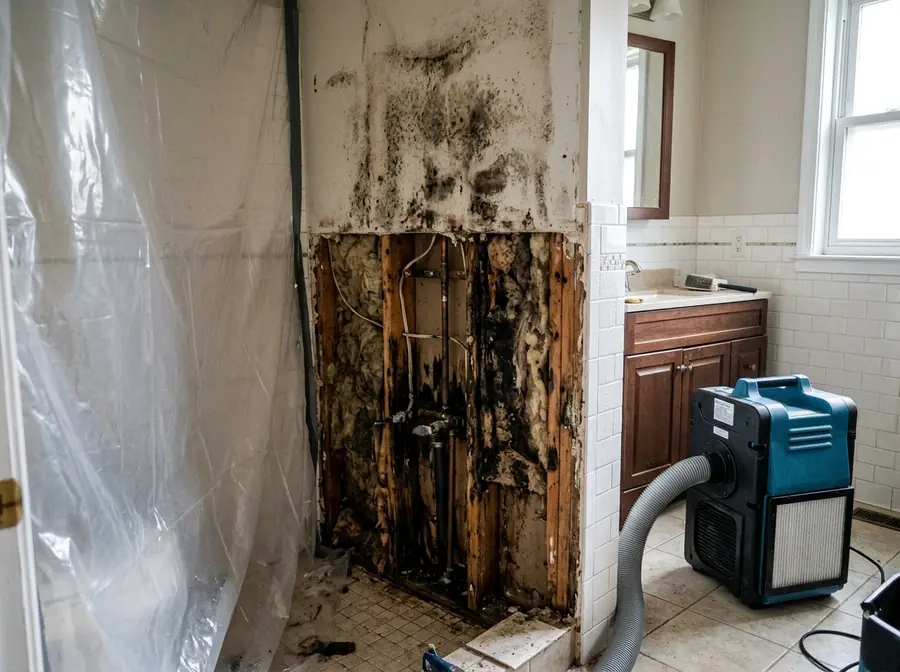
Mold remediation starts with moisture investigation
Mold spores are common in the environment and can enter buildings through ordinary air movement, doors, windows, dust, and objects brought inside. Their presence alone does not establish that a building has an active mold problem. Growth is more likely when spores settle on materials that remain damp and conditions allow moisture to persist. A lasting response therefore requires attention to the source of dampness as well as the affected materials.
Moisture may remain inside drywall, insulation, wood framing, carpet backing, flooring layers, and cabinet bases after a leak has stopped. A wall surface can feel dry while moisture remains behind it. A musty odor can justify further investigation, but it does not identify a mold species or show exactly where growth is located. Color is not a reliable way to identify mold or determine its health significance.
Covering a stain with paint or applying a household product does not prove that the material is clean, dry, or suitable to remain. If the source continues, growth may return. If materials have been wet for an extended period, a qualified assessment may be needed to understand the scope before removal or cleaning decisions are made.
Where moisture can collect in Bedford homes and buildings
Bathrooms contain showers, tubs, sinks, toilets, drains, supply lines, and ventilation systems. A leak at a fixture connection may wet the floor or cabinet base, while condensation can form on cooler surfaces when humid air is not adequately removed. Repeated moisture around a ceiling, window, or wall joint deserves attention to the source rather than repeated surface cleaning.
Kitchens and utility areas have appliance connections that may leak slowly. Washing machines, dishwashers, refrigerators with water dispensers, and water heaters depend on hoses, valves, drains, and fittings. Water can travel under appliances and cabinets or into adjoining rooms. A plumber or appliance technician may be needed to inspect the failed connection and prevent another leak.
Roofing and exterior openings can allow rainwater into attics, ceilings, and wall assemblies. Water may move along framing before appearing indoors. A stain on a ceiling does not necessarily mark the exact roof opening. Exterior doors, windows, flashing, siding, and penetrations can also be pathways for water entry and may require a qualified building or roofing professional.
In multi-unit buildings, shared walls, ceilings, plumbing risers, and neighboring units can complicate moisture tracing. A leak originating in one unit may affect materials in another. Property managers may need to coordinate access and source repairs across more than one space. The assessment should distinguish the observed damage from assumptions about where it began.
Bedford Public Works and private building plumbing
The City of Bedford Public Works Department oversees municipal water, wastewater, street, traffic, and stormwater infrastructure. Its official information describes city water distribution and wastewater collection responsibilities and provides contacts for public utility concerns. The department's emergency dispatch information also covers certain public works matters outside normal office hours.
Municipal infrastructure and plumbing inside a private property are different systems. A city water main, public sewer, private service connection, interior supply pipe, sink drain, and appliance hose may involve different repair responsibilities. If you suspect a public water or wastewater problem, contact the city through its official Public Works channels. If the moisture comes from an interior fixture, appliance, roof, or private building component, arrange an appropriate qualified trade to identify and repair it.
The city's emergency-management office coordinates preparedness and response for larger local emergencies and works with other agencies. That public role is not a substitute for a property-specific mold assessment. An indoor moisture concern still needs to be evaluated at the building, with attention to the actual source, materials, and conditions.
For current municipal information, consult the Bedford Public Works page and the Bedford Emergency Management page. Neither page should be interpreted as evidence that a particular Bedford neighborhood has a mold problem.
When professional mold assessment is appropriate
Consider professional advice when visible growth is extensive, appears to extend behind walls or ceilings, returns after cleaning, follows a significant water loss, involves HVAC equipment, or is associated with a persistent odor and uncertain moisture source. Assessment may also be useful where a property manager, owner, or insurer needs documented information before work is authorized.
Testing is not automatically required for every visible concern. A qualified assessment professional can explain whether sampling or other investigation will answer a useful question. Air samples alone are not a universal pass-or-fail test for an entire building. A sample represents the conditions and location at the time it was collected and should be interpreted in the context of the property inspection.
Do not use color or smell to diagnose a mold species. If occupants have health concerns, they should speak with a healthcare professional. A restoration provider can describe building conditions and the work it performs but should not diagnose illness, claim a specific medical effect, or guarantee a health outcome.
Texas rules for mold assessment and remediation
The Texas Department of Licensing and Regulation (TDLR) regulates mold assessment and mold remediation as separate activities. A mold assessment consultant evaluates building conditions and may prepare a remediation protocol when required. A mold remediation contractor performs regulated remediation work in accordance with the applicable requirements. Workers may also need the appropriate license or registration for the tasks they perform.
Texas rules include independence and conflict-of-interest restrictions. In general, the same person or company cannot perform both regulated assessment and remediation on the same project where prohibited, subject to a narrow exception for certain school-district work. Property owners should ask who will assess the building, who will prepare any protocol, and who will perform remediation. The arrangement must comply with current TDLR requirements.
Credentials are not interchangeable. A mold assessment consultant license, mold remediation contractor license, and worker registration relate to different roles. Plumbing, electrical, HVAC, roofing, and construction credentials cover other scopes. A permit is not a blanket statewide license. Ask for the specific credentials relevant to the work and verify current status using official TDLR resources.
For current information, consult the TDLR mold licensing FAQs and Texas mold-related laws and rules. This page is general educational information and is not legal advice.
What a mold remediation project may involve
The initial review considers the building, moisture history, visible growth, affected materials, occupancy, and access. If regulated assessment is required, the independent qualified professional may inspect and prepare a written remediation protocol. That protocol may define the work area, containment, cleaning or removal requirements, and any verification steps that apply.
Remediation may involve protecting unaffected rooms, controlling access, establishing containment, using suitable filtration or dust controls, removing materials that cannot be effectively cleaned, and cleaning remaining surfaces with appropriate methods. The exact scope depends on the size and location of the affected area, material types, building layout, and any applicable protocol. There is no universal process for every Bedford property.
Some porous materials, such as certain drywall, insulation, ceiling tiles, carpet backing, or composite products, may need removal if they cannot be cleaned effectively. Other materials may be suitable for cleaning. Decisions should be based on material condition and project requirements, not a blanket promise that every item can be saved or that all affected materials must be discarded.
Containment may include barriers, controlled entry, and filtration equipment where appropriate. Occupants should follow instructions about restricted areas, belongings, pets, and re-entry. Do not remove barriers or move equipment without authorization. Once remediation is complete, reconstruction may be needed to replace removed materials and restore finishes.
Correct the source before closing the building assembly
Remediation is not a substitute for repairing the cause of moisture. A plumber may repair a pipe or fixture, a roofer may address a roof opening, an HVAC professional may investigate condensation or a drain issue, and a building contractor may repair damaged framing or exterior components. The project scope should explain which repairs are included and which require another qualified trade.
Where water damage has occurred, extraction and structural drying may be appropriate before reconstruction. Moisture checks can help assess drywall, wood, flooring, insulation, and other materials. Air movement and dehumidification should be selected and monitored for the property. Equipment placement and drying duration depend on the material, saturation, temperature, humidity, and building design.
The EPA recommends drying wet or damp materials within 24 to 48 hours when possible to reduce the chance of mold growth. This is a practical prevention target rather than a guarantee. If materials remain wet or the source is unresolved, a building may continue to have moisture concerns. Our water damage restoration hub explains extraction and drying in more detail.
Safe steps for Bedford occupants
- Keep people and pets away from extensive suspected growth and damp, damaged materials.
- Avoid dry brushing, sanding, scraping, or aggressively scrubbing a large affected area.
- Do not use ordinary fans to move air from the affected room into other occupied spaces.
- Never mix bleach with ammonia, acids, or other cleaning products.
- Do not enter standing water where electrical equipment or wiring may be affected.
- Close an accessible water shutoff only if it can be reached safely.
- Notify a landlord, property manager, owner, or facilities contact if applicable.
- Keep a record of when the issue was noticed and what repairs have already been attempted.
Do not disturb materials that may contain asbestos or lead-based paint. Older building materials may require specialist evaluation before cutting, sanding, or removal. If the affected area is extensive or the source is uncertain, arrange qualified advice rather than attempting a large DIY cleanup.
Insurance, rentals, and project documentation
Insurance coverage for mold-related work depends on the cause of moisture, policy language, exclusions, limits, endorsements, notice requirements, and the insurer's decision. Sudden accidental water discharge may be treated differently from long-term seepage, maintenance issues, surface water, or flood losses. Contact the insurer or agent and review the policy rather than assuming a remediation project will be covered.
In a rental or multi-family building, responsibility may involve the tenant, landlord, property manager, building owner, or a neighboring unit. Report moisture promptly and follow the property's process for access and repairs. If a shared pipe or wall is involved, the parties may need to coordinate inspections and source correction.
Keep records of the moisture event, safe photographs, repair invoices, assessment findings, remediation protocol, work authorizations, and communications. Ask each professional to explain their role and provide relevant documentation. A restoration provider cannot guarantee insurance approval or make the insurer's coverage decision.
Frequently asked questions about Bedford mold remediation
Does dark mold always mean a dangerous species?
No. Color alone cannot identify a mold species or establish health risk. A qualified assessment focuses on building conditions and the questions that need to be answered.
Can I clean a large mold-affected wall myself?
Do not disturb extensive suspected growth or remove large areas of contaminated material as a DIY project. Arrange qualified advice and avoid actions that spread dust or debris.
Does every project need mold testing?
No. Testing is not automatically necessary in every case. A qualified assessment professional can explain whether sampling is appropriate for the property and purpose.
Can the same provider assess and remediate?
Texas rules distinguish the activities and include independence requirements. Ask who will perform each regulated role and verify that the arrangement complies with current TDLR rules.
How long does remediation take?
Timing depends on the area, materials, containment, drying, access, assessment requirements, and repairs. A schedule can be discussed after the scope is understood.
Discuss mold removal and remediation in Bedford
If you have visible growth, a musty odor, or moisture damage at a Bedford property, explain when the issue began, whether the moisture source has been repaired, which rooms are affected, and whether the building is occupied. Home Mold Water Fire Damage has more than 13 years of restoration experience, trained technicians, professional equipment, local operations serving communities across our coverage area, and 24/7 emergency response. We can discuss the appropriate next step and confirm whether your address and project requirements can be accommodated.
Explore our Bedford restoration services page, the mold removal and remediation hub, the water damage restoration hub, and the focused guide to mold after water damage. For immediate danger, contact emergency services first.