Confirm property access and responsibility first
Naval Air Station Joint Reserve Base Fort Worth is an active military installation with controlled access. A property inside the installation is different from a home or business in the surrounding civilian community. Outside contractors may need visitor sponsorship, identification, escort arrangements, advance approval, or other work authorization. A service-area listing does not grant access to the installation or permission to work in restricted buildings.
When contacting a provider, explain whether the property is on the installation, in nearby civilian housing, or elsewhere in the broader 76127 area. If the address is inside the installation, contact the appropriate housing office, facilities representative, property manager, or sponsoring contact to determine the current procedures. Ask who is responsible for approving the work, what documentation is required, and whether there are rules for photography, equipment, waste, and work hours.
Responsibility for moisture repairs may also depend on the property arrangement. A resident, landlord, housing office, facilities team, or building owner may have different duties. The source of the moisture should be reported to the responsible party, and access for assessment or remediation should be coordinated before a visit is arranged.
Mold growth is a moisture condition
Mold spores are part of the wider environment and can enter buildings through normal air movement, doors, windows, clothing, and dust. Their presence alone does not prove that a property has an active mold problem. Growth is more likely when spores settle on a material that remains damp and has suitable conditions. A plumbing leak, roof opening, condensation, water intrusion, or incomplete drying can create those conditions.
Removing a visible patch without correcting the moisture source may leave the underlying problem in place. Damp drywall, insulation, carpet backing, wood, and cabinet materials may hold moisture after the surface appears dry. A musty smell can justify further investigation, but it does not identify the source or prove the extent of growth. Color is not a reliable way to identify a mold species or determine its health significance.
Common sources of moisture in residences and facilities
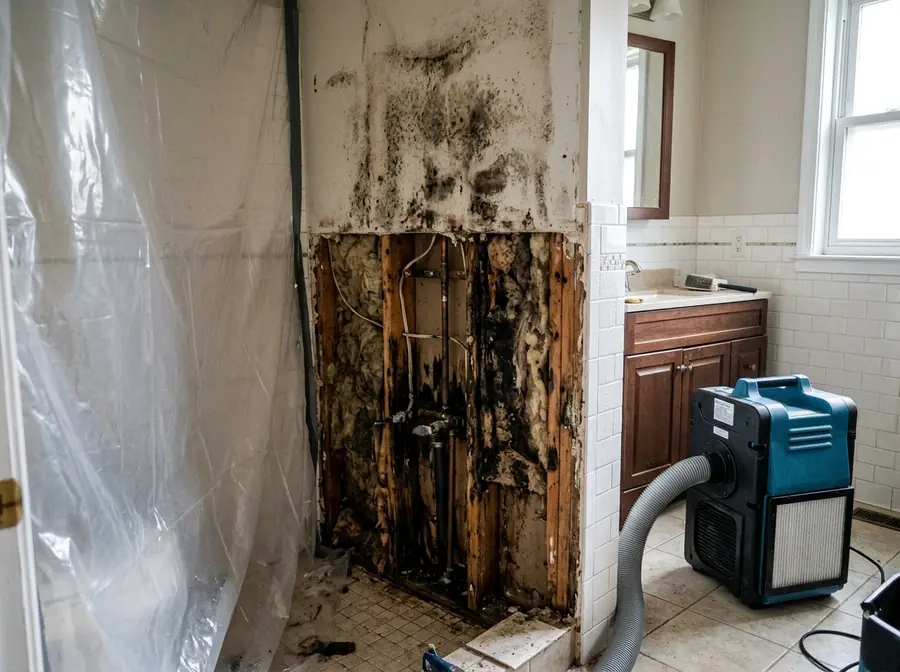
Bathrooms can develop repeated moisture from showers, tubs, sinks, plumbing connections, and condensation. Poorly functioning exhaust fans may allow humidity to remain on ceilings and walls. A leak at a toilet connection, shower enclosure, tub drain, or supply line can wet concealed materials before it becomes visible.
Kitchens and utility rooms have water lines, appliance connections, drains, and fixtures that can fail. Dishwasher hoses, refrigerator water lines, washing-machine connections, and water heaters may leak slowly. Water can collect beneath appliances or inside cabinets, where it may not be noticed immediately.
Roof assemblies, windows, exterior doors, and wall penetrations can admit water during rain or after a building component fails. Water may follow framing before appearing indoors. Condensation may also occur where humid air meets cooler surfaces or where ventilation and mechanical systems are not functioning as intended. A qualified roofer, plumber, HVAC professional, or building contractor may be needed to identify and correct the source.
These are general building conditions, not claims about a particular building or neighborhood on the installation. The moisture pathway must be established at the actual property.
When a professional mold assessment may be needed
Professional advice is appropriate when growth is extensive, appears inside walls or ceilings, returns after cleaning, follows a significant water loss, involves HVAC equipment, or occurs in a building with complex occupancy or access rules. It may also be necessary when the moisture source is uncertain or when Texas regulations require a mold assessment and remediation protocol.
Testing is not automatically required for every visible concern. A qualified assessment professional can explain whether sampling or other investigative work is appropriate and what the findings can and cannot establish. Air sampling alone is not a universal pass-or-fail test for an entire building. The scope of assessment should match the question being asked.
Do not make medical conclusions from a visual inspection or use color to identify a mold species. If occupants have health concerns, they should consult an appropriate healthcare professional. A restoration provider can describe building conditions and work within its scope, but should not diagnose illness or promise a health outcome.
Texas mold assessment and remediation rules
The Texas Department of Licensing and Regulation (TDLR) regulates mold assessment and mold remediation as distinct activities. A mold assessment consultant evaluates conditions and may prepare a remediation protocol when required. A mold remediation contractor performs regulated remediation work under the applicable rules. Workers may also need the appropriate licenses or registrations for the tasks they perform.
Texas rules include independence and conflict-of-interest restrictions. In general, the same person or company should not perform both regulated assessment and remediation on the same project where prohibited. Property owners should ask who will conduct the assessment, who will prepare any protocol, who will perform remediation, and how those roles comply with current TDLR requirements.
Credentials are not interchangeable. A mold assessment consultant license, mold remediation contractor license, and worker registration relate to different activities. Plumbing, electrical, roofing, building, and other trade credentials cover separate scopes. Ask for the relevant credentials and verify current status through official TDLR resources rather than relying only on a general statement or logo.
For official information, consult the TDLR mold licensing FAQs and the Texas mold-related laws and rules. The exact requirements depend on project circumstances and applicable exceptions. This page is general information, not legal advice.
What mold remediation may involve
The first stage is to understand the property, the moisture source, visible conditions, affected materials, and any access or occupancy restrictions. If regulated assessment is required, the appropriate independent professional may inspect the property and prepare a written protocol. The protocol may describe the work area, containment, removal or cleaning requirements, and any verification steps relevant to the project.
Remediation may include protecting unaffected spaces, establishing containment, using suitable controls to limit movement of dust and debris, removing materials that cannot be cleaned effectively, and cleaning remaining surfaces with appropriate methods. The work varies with the location and extent of growth, the materials, the building layout, and the protocol where one applies.
Some porous materials, such as certain drywall, insulation, ceiling tiles, or carpet backing, may need removal if they cannot be adequately cleaned. Other materials may be suitable for cleaning. Decisions should be based on the condition of the material and project requirements, not a blanket promise that all materials can be saved or that everything must be discarded.
Containment may involve barriers, controlled access, and filtration equipment depending on the project. Occupants and facility personnel should follow instructions about restricted areas and re-entry. Do not remove barriers or move equipment without authorization. If the property is on the installation, all controls must also follow site rules.
Correcting the moisture source is essential. A plumber may repair a pipe, a roofer may address a leak, an HVAC professional may evaluate condensation or ventilation, and a building contractor may replace damaged materials. Mold remediation does not automatically include every specialist trade repair.
What to do before a professional arrives
Keep people away from extensive suspected growth and avoid disturbing affected materials. Do not dry brush, sand, scrape, or aggressively scrub large areas. These actions can spread dust and debris. Avoid using household fans in a way that moves air from the affected area into occupied rooms. Never mix bleach with ammonia, acids, or other cleaning products.
If there is an active leak, shut off an accessible valve only if it can be reached safely. Do not enter standing water where electrical equipment may be affected. Do not climb onto a wet roof or enter an unsafe attic. Contact the responsible property or facilities team and the appropriate qualified trade to address the source.
When safe and permitted, record when the condition was noticed, whether a water event occurred, which rooms or materials are affected, and what repairs have already been attempted. Follow site rules about photographs and records. Do not photograph restricted spaces or delay urgent action to collect images.
Water damage and mold prevention
After a leak or water loss, moisture can remain inside drywall, insulation, framing, flooring, and carpet backing after standing water is removed. A surface that feels dry is not proof that the full assembly has dried. Depending on the event, extraction, moisture measurement, structural drying, and dehumidification may be appropriate.
Not every water loss results in mold, but leaving wet materials unaddressed can create conditions for growth. If a musty odor or visible growth appears after an earlier leak, further assessment may be appropriate. Do not assume that painting over a stain or applying a household spray resolves the source.
Our water damage restoration hub explains extraction and drying, while the focused mold after water damage guide discusses concerns following a leak. The mold removal and remediation hub provides a wider overview.
Insurance, housing, and project records
Coverage for mold-related work depends on the cause of moisture, policy wording, exclusions, limits, endorsements, notice requirements, and the insurer's decision. If the property is government-owned, leased, part of privatized housing, or managed under a separate arrangement, the responsible party and claim process may differ from an individually owned home. Contact the insurer or property authority for instructions before authorizing work when approval is required.
Keep records of the moisture event, repair invoices, photographs where permitted, assessment findings, communications, and work authorizations. Ask the assessment and remediation professionals to explain their separate roles and provide the relevant project documents. No contractor can guarantee insurance approval or reimbursement.
Frequently asked questions about NAS JRB mold remediation
Can a contractor enter the installation without approval?
Do not assume so. Contractor access may require sponsorship, identification, escort, or advance work authorization. Confirm current requirements with the responsible installation or property contact.
Does ZIP code 76127 mean the property is on the installation?
No. A ZIP code may cover a broader area and does not establish whether a particular address is inside a controlled installation. Confirm the exact property location and access status.
Does every mold concern require testing?
No. Sampling is not automatically required in every situation. A qualified assessment professional can explain whether testing is appropriate for the conditions and questions involved.
Can the same company assess and remediate mold?
Texas rules distinguish the activities and include independence requirements. The roles must be arranged in compliance with current TDLR requirements. Ask who will perform each regulated activity and verify credentials.
Can I clean extensive mold myself?
Do not disturb extensive suspected growth or remove large areas of contaminated material as a DIY project. Avoid dry brushing, sanding, or using fans that may spread debris. Arrange qualified advice.
How long does remediation take?
Timing depends on the affected materials, area, containment, drying, assessment requirements, site access, and repairs. A schedule can be discussed after the project is evaluated.
Discuss mold removal and remediation for the NAS JRB area
If you have visible growth, a musty odor, or moisture damage at a property connected with Naval Air Station Joint Reserve Base Fort Worth, explain the exact property location, when the issue began, whether the source has been repaired, and what access approvals may be required. Home Mold Water Fire Damage has more than 13 years of restoration experience, trained technicians, professional equipment, local operations serving communities across our coverage area, and 24/7 emergency response. We can discuss the appropriate next step and confirm whether the address, scope, and access arrangements can be accommodated.
Explore our NAS JRB Fort Worth restoration services page, the mold removal and remediation hub, and the contact page. For installation procedures and Texas regulatory questions, use official Navy and TDLR resources.