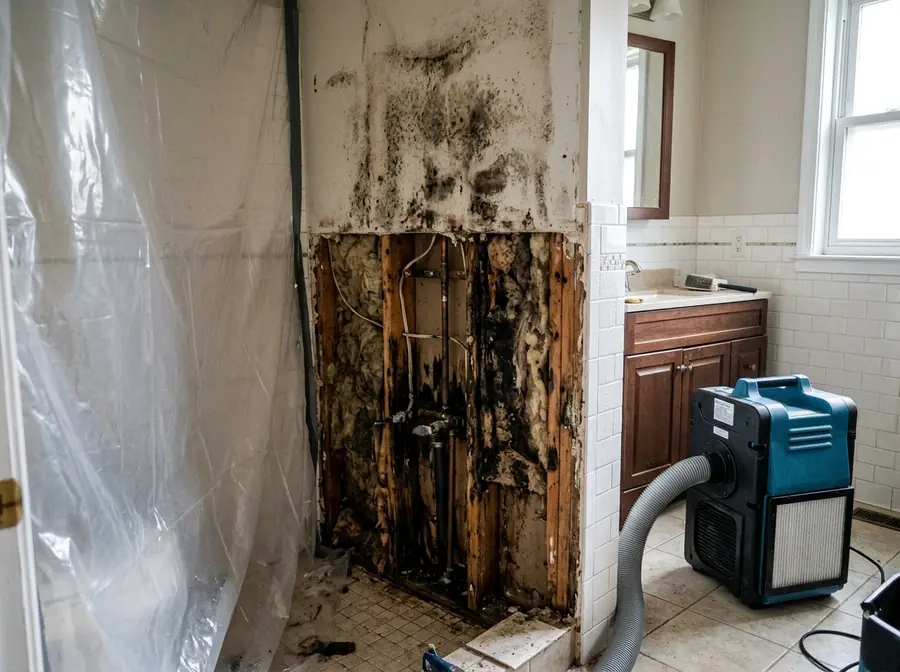
Why mold develops in buildings
Mold is common in the environment. Indoor growth becomes a building concern when moisture remains on or inside materials long enough to support it. Water from a plumbing leak, roof opening, appliance failure, overflowing fixture, storm intrusion, or condensation may affect drywall, wood, insulation, carpet, ceiling materials, and contents. If the moisture source is not corrected, visible growth can appear or remain concealed behind finishes.
A dark mark does not identify a mold species. Discoloration can have several causes, and appearance alone cannot determine species or health risk. A musty odor can justify further investigation but does not reveal exactly where growth is located. The history of the building, the water source, the affected materials, and moisture conditions all matter.
Forest Hill properties vary in layout, roof design, plumbing, ventilation, and maintenance history. A bathroom concern may involve a slow leak around a fixture; an attic issue may relate to a roof opening or condensation; and a commercial building may have shared plumbing or HVAC equipment. A meaningful plan is based on the specific property rather than a generic assumption about a city or ZIP code.
Texas mold assessment and remediation rules
Texas regulates certain mold assessment and remediation activities through the Texas Department of Licensing and Regulation (TDLR). The roles are different. A licensed mold assessment consultant or other appropriately licensed assessment professional may inspect, evaluate, and prepare a written remediation protocol where required. A licensed mold remediation contractor performs the remediation work described in the applicable scope or protocol.
As a general rule, the same licensee cannot perform both regulated mold assessment and mold remediation on the same project, subject to a narrow statutory exception involving certain school districts. A person or company may hold credentials in both areas, but that does not authorize the same licensee to take both roles on one project where the separation rule applies. Ask who will perform the assessment, who will carry out remediation, and who is responsible for any post-remediation assessment.
Whether a project is regulated or exempt can depend on the size of the affected area, property type, owner involvement, and other statutory conditions. Do not decide that an exemption applies based only on a quick visual estimate. Check current TDLR information at Mold Assessors and Remediators, the program FAQ, and the laws and rules. This page is educational and is not a legal opinion about a specific building.
When to arrange a mold assessment
An assessment may be useful when a property owner needs to understand the extent of visible or suspected growth, investigate a recurring moisture issue, establish what materials may require remediation, or obtain a written protocol for a regulated project. Sampling is not automatically required in every case. A qualified assessor should explain the question that a sample is intended to answer and how the result will guide a decision.
Laboratory results without a building inspection and moisture history can be difficult to interpret. A useful evaluation considers where water entered, how long materials may have remained damp, whether the source was repaired, what surfaces are affected, and whether growth may be hidden. If the project requires a written protocol, it should describe the work area, containment, materials to be removed or cleaned, protective measures, and criteria for completion.
Do not cut open walls, pull up flooring, remove ceiling tiles, or disturb suspected growth to investigate on your own. Concealed electrical wiring, plumbing, insulation, and potentially hazardous building materials may be present. A qualified professional can determine an appropriate and safer method.
What a remediation project may include
Correcting the moisture source
The moisture source must be addressed or the problem may recur. A leaking pipe may require a licensed plumber; a roof opening may need a roofer; and condensation may require an HVAC or building-envelope specialist. Exterior drainage, failed sealant, or an appliance connection may also need repair. The remediation scope should identify which source repairs are included and which are assigned to another trade.
Containment and occupant protection
Where required by the project protocol, containment helps separate the work area from adjacent occupied spaces and manage dust or debris. The plan should explain the work-zone boundary, access route, protective equipment, and any restrictions on room use. The appropriate approach depends on the affected materials, area, building occupancy, and project requirements.
Removal and cleaning of affected materials
Some materials can be cleaned with an appropriate method, while porous materials with established growth may need removal. Drywall, insulation, carpet, ceiling tile, wood, and contents each have different limitations. Decisions should follow the project assessment and protocol rather than a blanket promise that every item can be saved or every surface can be treated in place.
Drying and repair coordination
After remediation, remaining materials may need drying and moisture monitoring. Reconstruction can involve replacing drywall, insulation, flooring, cabinets, trim, or other finishes. Plumbing, roofing, electrical, HVAC, and structural work may require separate qualified professionals and permits. The property owner should understand who is responsible for each part of the project.
Post-remediation assessment
Some projects require a post-remediation assessment or clearance process under Texas rules and the applicable protocol. Where required, that assessment must be completed by an appropriately licensed professional who is independent of the remediation role as required by law. Ask for the relevant reports and any Certificate of Mold Damage Remediation documentation that applies.
Common moisture areas in Forest Hill homes and buildings
Bathrooms and laundry rooms
Bathrooms experience repeated moisture from showers, tubs, sinks, and cleaning. Leaking plumbing connections, failed caulk, damaged grout, or moisture behind a vanity can keep materials damp. Laundry rooms have washer hoses, drain connections, and sometimes water heaters. Repeated staining or odor should prompt investigation of the source instead of repeated surface wiping.
Attics and roof assemblies
Roof leaks can affect decking, insulation, framing, and ceilings. Condensation can also occur when moist indoor air reaches cooler surfaces or ventilation and air sealing are inadequate. Do not walk on ceiling joists or disturb attic insulation without understanding the hazards. If a roof opening is suspected, have a qualified roofer assess the exterior condition.
Walls, ceilings, and cabinets
Leaks from plumbing, windows, roofs, and appliances may travel behind finished surfaces. A ceiling stain may be below an upstairs plumbing leak or roof penetration. Cabinets can hide a slow leak at a sink, dishwasher, or refrigerator line. A dry-looking surface does not prove that the material behind it is dry.
Floors and lower areas
Water may move under carpet, laminate, hardwood, or resilient flooring and affect the subfloor or baseboards. Crawlspaces and enclosed lower areas may have plumbing leaks, ground moisture, or drainage problems. Do not enter a confined or unsafe space to inspect it, especially where electrical equipment, pests, or contaminated water may be present.
Forest Hill's public works and stormwater information
The approved service-area information identifies Forest Hill ZIP code 76119 and includes Forest Hill Village, Forest Hill East, Forest Hill South, Bluebonnet Hills, Heritage Heights, and Forest Oaks. These area names help orient a reader but do not establish the moisture history or construction of an individual property.
Forest Hill's Public Works Department describes responsibilities for water, sewer, and streets and publishes information about the city's stormwater management program. Its program materials describe municipal stormwater-quality measures, including education, public involvement, illicit-discharge detection, construction runoff controls, and post-construction management. These are public infrastructure and water-quality responsibilities; they do not replace a private building assessment when a roof, pipe, appliance, or interior material becomes wet.
If you suspect a municipal water-main or sewer-system problem, contact the city department responsible for the public system. A private plumbing leak may need a licensed plumber. If the water source is not clear, avoid assuming responsibility and document what happened. The remediation plan should distinguish public utility concerns from damage to private walls, floors, cabinets, and contents.
Stormwater management is relevant to understanding runoff, but it does not prove that a particular street or parcel has flooded. Water entry depends on local grading, elevation, drainage paths, foundation openings, roof condition, and the weather event. If a storm has affected the property, identify where water entered and whether the source has been corrected before deciding the remediation scope.
Safe steps while a mold concern is investigated
- Keep children, pets, and occupants away from extensive or disturbed growth.
- Do not enter standing water where electrical wiring or equipment may be affected.
- Avoid sanding, scraping, dry-brushing, or aggressively disturbing extensive growth.
- Never mix bleach with ammonia, acids, or other cleaning products.
- Do not paint over visible growth or use fragrance to mask a musty odor.
- Do not disturb materials that may contain asbestos or lead-based paint.
- Photograph visible conditions from a safe location and record the moisture history.
- Notify a landlord, property manager, insurer, or repair professional as appropriate.
The U.S. Environmental Protection Agency emphasizes moisture control as the key to mold control and recommends drying wet or damp materials within 24 to 48 hours where possible. This is a practical prevention target, not a guarantee. Conditions vary with material, temperature, water source, and the time a surface remains damp.
Residential, rental, and commercial mold projects
A residential project may involve one bathroom, an attic, a bedroom wall, a cabinet area, or multiple rooms after a water event. Occupants may need guidance about access, belongings, pets, and whether unaffected parts of the home can remain in use. A landlord or property manager may need to coordinate access, tenant communication, maintenance records, and source repairs. Texas licensing requirements should be considered regardless of whether the building is owner-occupied or rented.
Commercial properties may have shared roofs, plumbing risers, HVAC equipment, storage rooms, tenant spaces, and common corridors. Building managers should identify who can authorize work, which areas need to remain operational, and how occupants will be notified. The assessment and remediation roles must remain properly separated where Texas law requires it.
Complex projects may involve a licensed mold assessment consultant, licensed remediation contractor, plumber, roofer, HVAC professional, electrician, or reconstruction contractor. Ask for a written scope that explains the sequence, the parties responsible, the materials affected, and any work that falls outside the remediation contract. Clear responsibilities help prevent a moisture-source repair from being overlooked.
Insurance and project cost considerations
Ask your insurer how to report the loss and what documentation is required. Keep photographs, maintenance records, repair invoices, professional reports, and copies of communications. If mold followed a plumbing leak, roof issue, appliance failure, or storm event, provide the known facts and avoid guessing about coverage. Ask whether the insurer wants to inspect before materials are removed.
Coverage depends on policy wording, cause of moisture, exclusions, limits, endorsements, and the insurer's decision. Gradual seepage, sudden leaks, maintenance issues, and floodwater may be treated differently. A restoration contractor cannot guarantee approval. Project cost also depends on the affected area, material types, access, containment, assessment needs, contents, source repair, and reconstruction. A site-specific written scope is more reliable than a generic per-square-foot estimate.
Related Forest Hill restoration pages
- Water damage restoration in Forest Hill — extraction and drying after leaks or water intrusion.
- Fire and smoke restoration in Forest Hill — soot, odor, and firefighting-water issues.
- Mold removal and remediation hub — broader service information and related topics.
- Mold inspection and testing — when an assessment or sampling question needs to be answered.
- Mold after water damage — moisture control after a leak or flood.
- Contact Home Mold Water Fire Damage — discuss the property and current availability.
Frequently asked questions about mold remediation in Forest Hill
Does a musty smell confirm mold?
No. It can be a reason to investigate moisture, but it does not identify a species or show the full extent of a problem. A building review should consider the history and materials.
Is mold sampling always necessary?
No. Sampling is not automatically required for every situation. A qualified assessor can explain whether testing will answer a specific question and how the result will guide the work.
Can I paint over a mold stain?
Painting does not correct the moisture source or remove growth. The affected materials and source of moisture should be addressed before finishes are restored.
Can one licensee assess and remediate the same project?
Texas generally separates regulated mold assessment and remediation roles on the same project, subject to a narrow school-district exception. Confirm the parties and current requirements with TDLR guidance.
Will mold return after remediation?
It can if moisture returns or the original source is not corrected. Plumbing, roof, ventilation, drainage, or condensation issues may need separate repairs.
Will homeowners insurance pay for mold work?
Coverage depends on the policy, cause of moisture, exclusions, limits, endorsements, and the insurer's decision. Ask the insurer about the specific loss.
Discuss a Forest Hill mold concern
If you have noticed visible growth, recurring discoloration, a musty odor, or damp materials after a water event in Forest Hill, contact Home Mold Water Fire Damage to discuss the property and the appropriate next step. Our company brings more than 13 years of restoration experience, trained technicians, professional equipment, and 24/7 emergency response. Where Texas rules apply, assessment and remediation must be performed by appropriately licensed professionals in the roles required by law.
Read about our Forest Hill water damage service, fire and smoke restoration, or use the contact page to discuss current availability.