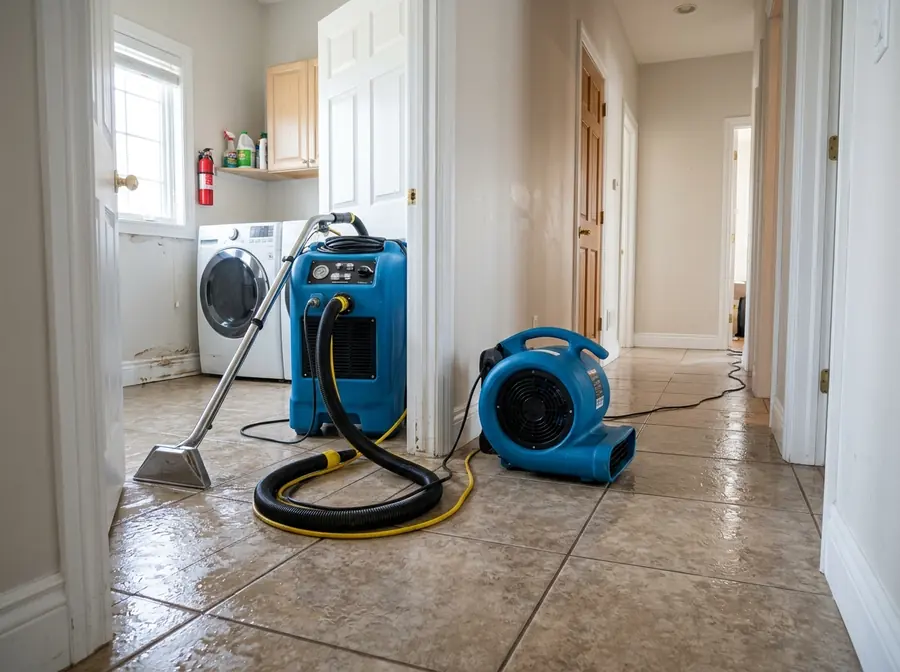
Why a building can look dry while materials remain wet
Water moves into porous materials and concealed spaces. Carpet may look dry at the surface while the backing or pad remains damp. A hardwood floor may feel dry while moisture remains in the subfloor. Drywall can absorb water at the bottom edge, and insulation behind it may retain moisture. Cabinet bases and wall cavities can hold water that is not visible from the room.
Moisture can also migrate. Water entering through a ceiling may move along framing before appearing elsewhere. A plumbing leak inside a wall can affect the opposite side of the partition or the floor below. A technician therefore needs to consider the route of the water and the building assembly, not just the first visible stain.
Leaving hidden moisture unaddressed can delay repairs and may create conditions that support mold growth. The U.S. Environmental Protection Agency emphasizes moisture control as the key to mold control and recommends drying wet materials promptly. Its 24-to-48-hour guidance is a practical prevention target, not a guarantee; actual drying needs depend on the materials and loss conditions.
What structural drying is designed to accomplish
Structural drying aims to reduce excess moisture in building materials to an appropriate level for the next stage of restoration. That may mean drying a floor assembly, wall, ceiling, framing, cabinet, or other component. The work may include extracting remaining water, establishing controlled air movement, lowering humidity with dehumidification, and checking the materials over time.
The objective is not to make every material reach one universal moisture number. Wood, drywall, concrete, flooring, and other materials behave differently. Readings must be interpreted according to the material, location, baseline conditions, and the project. A useful drying plan identifies what is being measured and why, rather than presenting a single reading without context.
Some materials may be suitable for drying in place. Others may be too damaged, contaminated, or inaccessible to restore safely and may need removal. A professional should explain the evidence behind those decisions and identify when additional inspection or specialist work is required.
Air movers: what they do and what they do not do
Air movers create controlled air movement across wet surfaces. This can help moisture evaporate from materials and enter the surrounding air, where dehumidification can remove it. Equipment placement depends on the room shape, surface, moisture pattern, and safety requirements. Airflow should be directed intentionally rather than simply aimed at the most visible wet spot.
Air movers do not remove water from the building by themselves. If moisture enters the air faster than it can be managed, indoor humidity can remain elevated. Air movement also does not establish that a wall cavity or subfloor is dry. Monitoring is needed to understand whether the material is responding and whether the setup should be adjusted.
After a sewage or floodwater event, ordinary air movement may be inappropriate until contamination has been handled. Moving air can spread contaminated particles or droplets. The water source and cleanup sequence must be considered before equipment is used.
Dehumidifiers and indoor moisture control
Dehumidifiers remove water vapor from indoor air. In a restoration project, they can support drying by reducing the moisture in the air around wet materials. The right equipment depends on the size of the affected area, moisture load, building conditions, and project objectives. A portable household unit is not necessarily designed for a substantial water loss or a concealed structural assembly.
Humidity readings are useful, but relative humidity changes with temperature. A room can show a different relative humidity as it warms or cools even if the total amount of water vapor changes less dramatically. Technicians consider temperature, humidity, material readings, and the condition of the space when evaluating progress.
ENERGY STAR notes that indoor relative humidity is generally best kept below 60 percent, ideally in a 30-to-50-percent range for ordinary household moisture management. Those are general indoor humidity recommendations, not a substitute for project-specific drying criteria. For more information about household humidity and dehumidifiers, see ENERGY STAR's dehumidifier guidance.
Moisture meters and monitoring during the drying process
Moisture meters and other diagnostic tools can help a technician evaluate how wet a material is and whether it is changing over time. Different meters use different methods and are suited to different materials. A reading on wood cannot automatically be compared with a reading on drywall or concrete. The location and depth of the measurement also matter.
Monitoring should be consistent enough to show trends. A technician may check selected points, compare affected and unaffected areas, record readings, and adjust equipment when progress changes. If a reading is unexpectedly high or does not improve, the cause may be a hidden source, a material that is slow to dry, an airflow issue, or an area that requires additional access.
Ask for an explanation of the monitoring approach. Which materials are being checked? Where are the measurement points? How often are readings taken? What criteria will be used to decide whether drying is complete? These questions help property owners understand why equipment remains in place and what needs to happen before repairs continue.
When materials need removal instead of drying in place
Not every wet building material can or should be saved. Removal may be appropriate when a material has lost structural integrity, is contaminated, cannot be accessed or dried adequately, or has been damaged beyond practical restoration. Porous materials exposed to sewage or contaminated floodwater may require removal rather than ordinary drying. Insulation can hold moisture inside a closed cavity and may need specialist evaluation.
Drywall may be retained in some circumstances and removed in others. Flooring decisions depend on the material, adhesive, underlayment, subfloor, and exposure. Cabinetry can absorb water through joints and unfinished edges. Wood framing may be dried and monitored if it remains structurally sound and can be accessed. The decision should be explained in the work scope, with the reason for removal or retention.
Before demolition, consider possible asbestos-containing materials and lead-based paint, especially in older buildings or areas with previous renovations. Do not cut, sand, scrape, or disturb suspect materials until the appropriate specialist has assessed them. Structural or electrical concerns may also require a separate trade or professional.
How the drying approach changes by material
Wood framing and subfloors
Wood can absorb and release moisture. A wet joist or subfloor may require monitoring over time, and the ability to dry it depends on access, airflow, material thickness, and the water source. Swelling, warping, delamination, or other damage can affect whether the material is suitable to retain. A structural professional may be needed if the component's integrity is in question.
Drywall and insulation
Drywall can wick water and lose strength. Insulation may retain moisture behind the wall surface. The assembly may need selective opening to inspect or dry the cavity. The decision depends on water category, exposure, material condition, and safe access.
Concrete and masonry
Concrete and masonry can hold moisture and release it slowly. Surface appearance may not reveal the moisture condition deeper in the material. Coatings, flooring adhesives, and finishes may also be affected. A material-appropriate assessment is needed before installing new finishes.
Flooring and cabinetry
Laminate, carpet, hardwood, tile assemblies, and cabinet materials have different moisture tolerances. A surface may look dry while underlayment, pad, grout joints, or cabinet bases remain damp. See our carpet and hardwood drying page for more flooring detail.
Drying after different types of water loss
A clean supply-line leak, appliance overflow, roof leak, stormwater intrusion, and sewage backup do not follow the same drying plan. The water source affects whether materials can be cleaned and retained, what protective equipment is needed, and whether porous materials should be removed. A contaminated water loss should not be treated as a clean-water drying job. Extraction, removal, cleaning, and sanitation may need to occur before drying equipment is used.
For a burst pipe, the plumbing source must be repaired before the structure can be protected from additional water. For storm intrusion, the roof or exterior opening must be addressed by a qualified trade. For a sewage backup, the wastewater source and contaminated materials require appropriate handling. The restoration plan should distinguish source repair from mitigation and reconstruction.
Explore our specific guides for burst pipe cleanup, flood water extraction, sewage backup cleanup, and storm and roof leak damage.
Haltom City property and climate considerations
Haltom City and the surrounding Tarrant County area experience seasonal changes in temperature and humidity. Indoor moisture can come from plumbing failures, rain intrusion, air-conditioning condensate, bathrooms, kitchens, and other everyday sources. Outdoor humidity alone does not prove that a building needs structural drying; the condition of the materials and the source of water matter.
Local roads such as Denton Highway, Broadway Avenue, Beach Street, Haltom Road, and Northeast Loop 820 help identify general parts of the city. The approved coverage area includes ZIP code 76117 and neighborhoods such as Browning Heights, Diamond Oaks, Fossil Ridge, Haltom Acres, Meadow Oaks, Oak Knoll, Oakview, Shady Dell, and the other areas listed in our service areas directory. Nearby communities include North Richland Hills, Hurst, Bedford, Fort Worth, Arlington, and other listed Tarrant County locations.
Do not infer that a specific property has a moisture or flood problem based only on its neighborhood or proximity to a creek. Site grading, plumbing, roof condition, ventilation, and the actual water event are more useful evidence.
What property owners can expect during a drying project
Before equipment is installed, the technician should explain the affected areas, the equipment plan, access requirements, and any safety restrictions. Equipment can create noise, warmth, airflow, and additional electricity use. Cords and hoses can create trip hazards, so keep walkways clear and do not unplug or move equipment without speaking to the project contact.
Monitoring visits may be needed to check readings, reposition equipment, and decide whether additional access or material removal is necessary. If the scope changes, ask for the reason and the proposed adjustment before authorizing additional work. Drying completion is not the same as full reconstruction; drywall installation, flooring, cabinetry, painting, and other repairs may follow as a separate phase.
Our restoration process page describes the wider sequence from initial contact through project review. The water damage restoration hub explains the full service category.
Questions about structural drying and dehumidification
How long does structural drying take?
It depends on the water source, materials, moisture level, building conditions, and access. A fixed duration cannot be promised before the affected assembly is assessed and monitored.
Does a dehumidifier dry walls by itself?
Not necessarily. Dehumidification reduces water vapor in the air, while airflow and material access help moisture leave the building components. Monitoring shows whether the combination is working.
Can I use my own household dehumidifier?
A household unit may help with ordinary humidity in some settings, but a water-loss project can require different capacity, placement, and monitoring. Do not operate electrical equipment in wet or unsafe areas.
How do you know when a wall is dry?
Technicians use appropriate tools and material-specific criteria, comparing readings and conditions over time. Appearance alone is not enough to confirm that a wall cavity is dry.
Will you remove drywall if it is wet?
Only when the material condition, water category, access, or drying limitations make removal appropriate. Ask for the reason and the affected area before work is authorized.
Arrange structural drying support in Haltom City
If a leak or other water event has affected your Haltom City property, contact Home Mold Water Fire Damage to discuss extraction, moisture assessment, structural drying, and the materials that may need attention. Our team has more than 13 years of restoration experience, trained technicians, professional equipment, and 24/7 emergency response.
For the broader service, visit the water damage restoration hub. To discuss the specific property and next step, use the contact page or review our restoration process.